
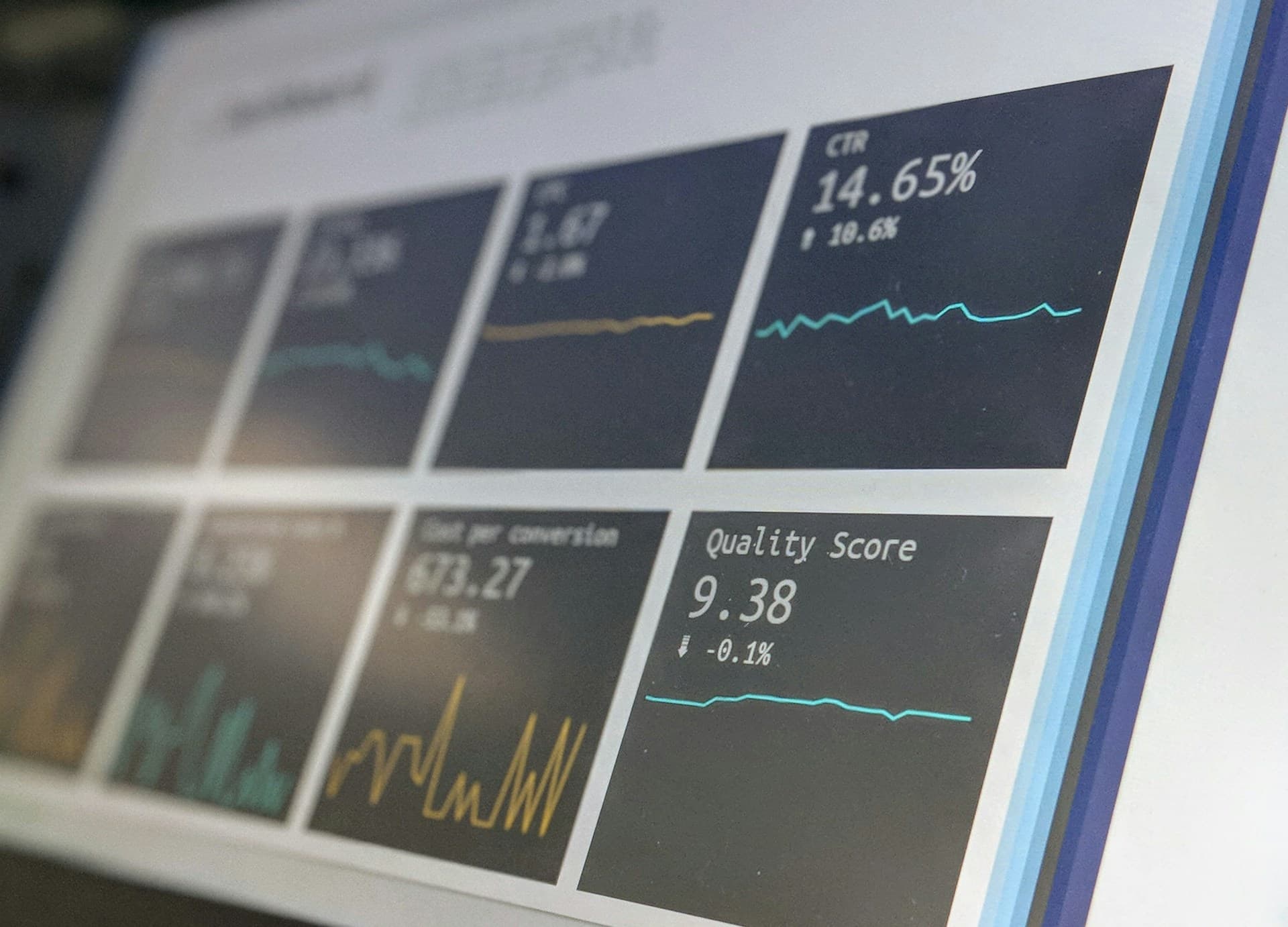
Machine learning pays off in business when it's aimed at a decision you already make repeatedly, with data you already collect, and a number you already track. Demand forecasting, fraud and anomaly detection, document processing, visual quality inspection, churn prediction, recommendations and support triage all fit that description. Most projects that disappoint don't fail because the model was weak. They fail because the data wasn't ready, nobody owned the model once it went live, or the business case was never tied to a KPI.
Adoption is no longer the question. The Stanford AI Index 2025 reports that 78% of organisations used AI in 2024, up from 55% the year before, and McKinsey's State of AI 2025 found that 88% of organisations regularly use AI in at least one business function. Value is the question: in the same McKinsey survey, only 39% of respondents reported any EBIT impact at enterprise level, and most of those said it was under 5%.
This guide is for operations, finance and product leaders, not data scientists.
Key Takeaways
- Start from a repeated, measurable decision, not from "we should use AI". The best ML use cases improve something you already measure.
- Each use case has a minimum data requirement. Check it before you fund the project: Gartner (2025) expects 60% of AI projects without AI-ready data to be abandoned through 2026.
- Judge ROI against a baseline (current error rate, handling time, loss rate) agreed before the build starts.
- Budget for monitoring and retraining. Models degrade as the world changes, and that's normal, not a defect.
What machine learning actually does for a business
Machine learning is software that learns patterns from historical examples and applies them to new cases. In practice it does one of four jobs: it predicts a number (next month's demand), classifies something (fraudulent or legitimate, defective or fine), extracts structured data from unstructured input (fields from an invoice, objects in an image), or ranks options (which product to show, which ticket to handle first).
That framing tells you what you're buying: a better forecast, a faster review queue or fewer manual checks, each with a cost today that you can measure.
It also helps to separate classic ML from generative AI. Large language models are excellent at drafting and summarising text, but many of the highest-return business problems are still structured prediction tasks on tabular data, images or documents. Those tend to be cheaper to run, easier to evaluate and easier to explain to an auditor. If you're weighing the two, our guide to a cost-effective AI strategy goes into the trade-offs.
Seven machine learning use cases by business function
Demand forecasting (operations, supply chain, finance)
Forecasting models predict future volumes, such as orders, footfall, call volumes or energy load, from historical patterns plus drivers like price, promotions, weather and holidays. Better forecasts reduce both stock-outs and excess inventory, and they make staffing plans less of a guess.
Forecasting applies well beyond retail. Our Punjab AQI dashboard, built for the Environment Protection & Climate Change Department of the Government of the Punjab, includes a 72-hour AI/ML air-quality forecast alongside GIS mapping. The underlying problem is the same as a sales forecast: learn from time-stamped history and external drivers, then give decision-makers enough warning to act.
Fraud and anomaly detection (finance, risk, compliance)
Anomaly detection flags transactions, claims, logins or sensor readings that don't fit normal patterns. Rules catch known fraud; ML catches the unusual combinations that rules miss and can rank alerts so investigators look at the riskiest first.
The stakes are real. The ACFE's Occupational Fraud 2024: A Report to the Nations estimates that a typical organisation loses 5% of revenue to fraud each year, and 43% of cases in its study were uncovered through tips rather than controls. Data-driven monitoring is one way to shift that balance. Teams in fintech usually start here.
Document processing and OCR (finance, operations, HR)
Invoices, purchase orders, delivery notes, KYC documents and claims forms still arrive as PDFs and scans. Modern OCR combined with ML extraction models can pull out the fields you need, check them against your systems and send only the uncertain ones to a person. The value is in handling time and error rates, not in removing people from the loop entirely.
Computer vision quality inspection (manufacturing, logistics, healthcare)
Camera-based models can spot surface defects, missing components, incorrect labels or damaged packaging at line speed. They work best where the defect is visible, the lighting and camera position are controlled, and you can collect labelled examples of both good and bad items.
The same techniques apply to medical imaging and security. Our AI disease detection and smart security camera projects (both for clients under NDA) are examples of computer vision development applied in very different settings. In regulated work like healthcare, the model is only one part of the system. Audit trails, access controls and human review carry as much weight.
Churn prediction (product, customer success, subscription businesses)
Churn models score each customer's likelihood of leaving in the next period, based on usage, support history, billing events and contract details. The model doesn't save anyone by itself. It tells your retention team where to spend limited time, so the business case depends on having a retention action worth taking.
Recommendations and personalisation (e-commerce, media, SaaS)
Recommendation systems rank products, content or next actions for each user. Models can add context like browsing session, season and stock levels. For e-commerce and retail teams, this is often the use case with the most direct revenue link.
Customer support triage (support, operations)
Classification models can tag incoming tickets by topic, urgency and sentiment, route them to the right queue and suggest relevant help articles. This is a good first ML project because the training data (historical tickets and their final categories) usually already exists in your helpdesk.
What data each use case needs
Use this table as a first check before you scope a project. If you can't name where the "data required" column comes from, fix that first.
| Use case | Data required | Typical KPI |
|---|---|---|
| Demand forecasting | 2+ years of time-stamped sales or volume history; prices, promotions, calendar, external drivers | Forecast error (MAPE), stock-outs, inventory holding cost |
| Fraud / anomaly detection | Transaction or event logs with confirmed fraud labels; customer and device attributes | Fraud loss rate, false-positive rate, investigator hours per case |
| Document processing / OCR | Sample documents per layout; the correct extracted values for a labelled subset | Straight-through processing rate, handling time per document, field error rate |
| Computer vision QA | Labelled images of good and defective items under production lighting | Defect escape rate, false reject rate, inspection throughput |
| Churn prediction | Customer usage, billing, support and contract history with known churn outcomes | Churn rate, retention-campaign uplift, net revenue retention |
| Recommendations | Interaction logs (views, clicks, purchases), product catalogue attributes | Conversion rate, average order value, click-through rate |
| Support triage | Historical tickets with final category, priority and resolution | First-response time, misrouted tickets, resolution time |
Two things often surprise leaders. First, labels are usually the bottleneck, not raw data. You may have millions of transactions but only a few hundred confirmed fraud cases. Second, the data has to match production conditions. A vision model trained on studio photos won't hold up under factory lighting.
Typical time-to-value
Timelines depend more on data readiness and integration than on modelling. As a rough guide, and without promising any specific project:
| Stage | What happens | Typical duration |
|---|---|---|
| Discovery and data audit | Confirm the decision, baseline KPI, data sources and label quality | 1-3 weeks |
| Proof of value | Build a first model on historical data and compare it with the baseline | 3-8 weeks |
| Production pilot | Integrate with live systems, add monitoring, run alongside the current process | 1-3 months |
| Scale and retrain | Extend to more products, sites or teams; set retraining schedule | Ongoing |
Support triage and document extraction often reach a pilot fastest because the data already exists and the integration points are narrow. Vision projects that need new cameras or fresh labelling take longer. Forecasting sits in between, depending on how clean your history is.
How to judge ROI on a machine learning project
The ML projects that pay off share one habit: they agree the baseline before anyone writes code. A workable ROI model has four parts.
- Baseline. What does the decision cost today? Hours spent on manual review, current forecast error, current fraud loss rate, current churn.
- Expected improvement range. Use the proof-of-value results on held-out historical data, not vendor claims. State a low and a high case.
- Full cost. Build cost, cloud and inference cost, integration, labelling, and the ongoing cost of monitoring and retraining. The Stanford AI Index 2025 found that the inference cost of a system performing at GPT-3.5 level fell more than 280-fold between November 2022 and October 2024, so compute is rarely the largest line now. People and integration usually are.
- Decision rule. What result in the pilot means "scale", "iterate" or "stop"? Write it down in advance.
Watch for metrics that look good in a notebook but don't move the business. A fraud model with 99% accuracy can be useless if fraud is 0.5% of transactions. Ask instead about precision (how many alerts are real) and recall (how much fraud is caught), and translate both into money and hours.
Why many machine learning projects stall
The gap between experiments and results shows up in every major survey. Gartner predicted in 2024 that at least 30% of generative AI projects would be abandoned after proof of concept by the end of 2025, citing poor data quality, inadequate risk controls, escalating costs and unclear business value. The same causes apply to classic ML.
Data readiness
In a 2025 Gartner press release, 63% of surveyed data management leaders said their organisations either did not have, or weren't sure they had, the right data management practices for AI. Typical problems include missing history, inconsistent IDs across systems, labels stored in someone's spreadsheet, and no agreed owner for the data.
No path to production (MLOps)
A model in a notebook isn't a product. It needs a reliable data pipeline, versioning, automated testing, deployment, access control and a rollback plan. That's MLOps, and it borrows heavily from standard DevOps practices. Teams that skip it end up with a demo that only one person can run.
Model drift and monitoring
Customer behaviour, supplier prices, fraud tactics and even camera lenses change over time. A model trained on last year's data slowly gets worse. Production ML needs monitoring for input drift (the data looks different), performance drift (accuracy drops once outcomes are known) and operational health (latency, errors). It also needs a retraining routine with a named owner.
Adoption by the people who use it
If the people using the output don't trust it, they ignore it. Explain why a score is high, show confidence levels, and design the workflow so people can override the model and have that feedback captured for retraining.
Scale is still early for most
Eurostat (2025) reports that 20% of EU enterprises with 10 or more employees used AI technologies in 2025, up from 13.5% in 2024, with large firms far ahead of small ones. In McKinsey's 2025 survey, only around 6% of respondents qualified as "AI high performers": those attributing 5% or more of EBIT to AI and reporting significant value from it. Disciplined execution is still a real advantage.
Frequently asked questions
What is the best first machine learning project for a mid-sized business?
Pick a task where historical data and outcomes already exist and the decision is frequent. Support ticket triage, invoice extraction and demand forecasting are common starting points because the data sits in systems you already run and the KPIs are easy to measure.
How much data do we need for machine learning?
It depends on the use case. Forecasting usually needs at least two years of history to capture seasonality. Classification problems need enough labelled examples of each outcome, and the rare class (fraud, defects, churn) is usually the constraint. A short data audit will tell you more than a general rule.
How long does it take to see ROI from machine learning?
A proof of value on historical data can often be completed within a few weeks, but measurable business ROI comes from the production pilot, which typically runs for one to three months. Projects with clean data and simple integrations move fastest.
Do we need our own data science team?
Not to start. You need a business owner for the decision, someone who understands the data, and access to ML engineering and MLOps skills. Many organisations use a partner for the first build and then decide whether to keep the model in-house.
What is model drift and how do we handle it?
Model drift is the gradual drop in accuracy as real-world conditions move away from the training data. Handle it by monitoring inputs and outcomes, setting alert thresholds, and retraining on a schedule or when performance falls below an agreed level.
Conclusion
Machine learning works in business when it's treated as a way to improve a specific, measured decision rather than as a technology project. Choose a use case with real data behind it, agree the baseline, plan for production and monitoring from the start, and scale what proves itself.
If you're deciding whether to build in-house or bring in a partner, our guide to choosing a software development partner covers the questions worth asking. VulcanTech's machine learning development and wider AI and ML solutions teams are senior-led, and we work on fixed-scope, dedicated-team or staff-augmentation terms. Since 2021 we've delivered 80+ projects across 16 countries. If you'd like a second opinion on where ML fits in your operation, book a free 30-minute discovery session with our team.